What it can run, and for how long
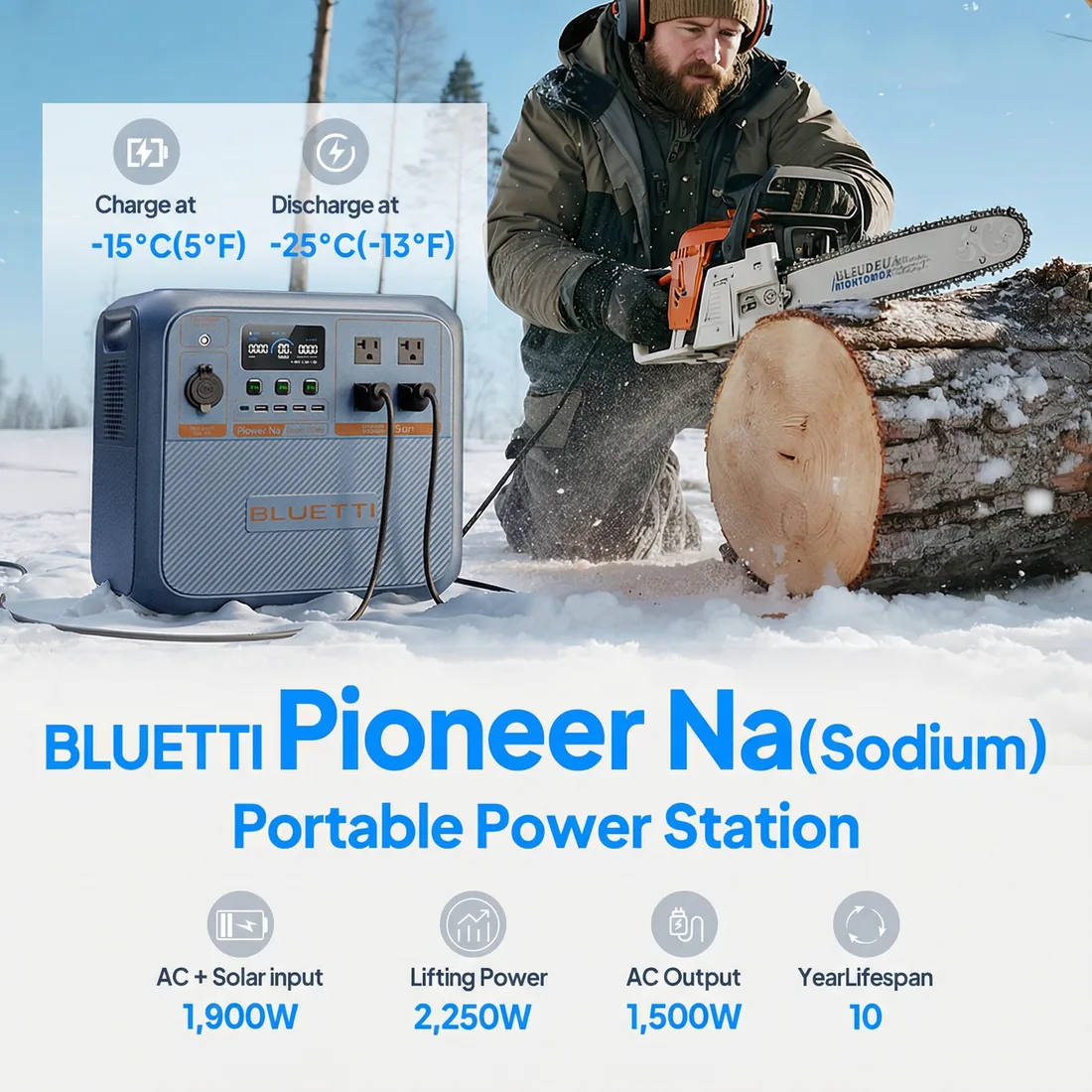
A power station is a battery with an inverter: it stores energy as watt-hours (Wh) and delivers it as AC watts (W). The BLUETTI 1,500W 900Wh stores 900 Wh, of which about 765 Wh reaches your appliances after losses, and its inverter limits the load to 1,500 W at a time.
| Appliance (typical) | Running / starting watts | Can it run it? | Runtime on a full charge | |
|---|---|---|---|---|
| Refrigerator (modern, about 18–22 cu ft) | 150 W / 600 W start | Yes | 12.8 h | |
| Chest freezer (about 7 cu ft) | 100 W / 400 W start | Yes | 21.9 h | |
| Sump pump (1/3 hp) | 800 W / 1,500 W start | Yes | 6.4 h | |
| Well pump (1/2 hp) | 1,000 W / 2,100 W start | Check surge | 3.8 h | |
| Gas furnace blower | 750 W / 1,500 W start | Yes | 2.0 h | |
| Window air conditioner (5,000–8,000 BTU) | 600 W / 1,800 W start | Check surge | 2.1 h | |
| CPAP with heated humidifier | 70 W | Yes | 10.9 h | |
| Home oxygen concentrator | 300 W | Yes | 2.5 h | |
| Wi-Fi router and modem | 25 W | Yes | 30.6 h | |
| LED television (55 in) | 100 W | Yes | 7.7 h | |
| LED lighting (10 bulbs) | 100 W | Yes | 7.7 h | |
| Laptop and charger | 60 W | Yes | 12.8 h | |
| Phones and tablets charging (4) | 40 W | Yes | 19.1 h | |
| Ceiling or box fan | 75 W / 150 W start | Yes | 10.2 h | |
| Microwave oven (1,000 W cooking) | 1,500 W | Yes | 5.1 h | |
| Coffee maker | 900 W | Yes | 8.5 h | |
| Garage door opener (1/2 hp) | 550 W / 1,100 W start | Yes | 2.9 days | |
| Washing machine | 500 W / 1,300 W start | Yes | 3.8 h | |
| Electric space heater (1,500 W) | 1,500 W | Yes | 31 min | |
| Central air conditioner (3-ton) | 3,500 W / 10,500 W start | No | — |
| Scenario | Running watts | Starting watts needed | Average draw | Fits | Estimated runtime |
|---|---|---|---|---|---|
| Essentials: refrigerator, router, lights, phones | 315 W | 765 W | 225 W | Fits | 3.4 h |
| Essentials + sump pump | 1,115 W | 1,815 W | 345 W | Check surge | 2.2 h |
| Essentials + furnace blower + TV | 1,165 W | 1,915 W | 700 W | Check surge | 1.1 h |
| Essentials + window air conditioner | 915 W | 2,115 W | 585 W | Check surge | 1.3 h |
Recharging
Recharge time depends on the source. Solar numbers below are our calculation for the panel wattage shown, assuming 75% real-world output and the approximate annual-average peak sun hours for each region; winter and cloud cover cut them sharply.
| Panel total | Basis | Florida and the Gulf Coast | Texas | California |
|---|---|---|---|---|
| 100 W | — | 2.3 sunny days | 2.4 sunny days | 2.2 sunny days |
| 200 W | — | 1.2 sunny days | 1.2 sunny days | 1.1 sunny days |
| 400 W | — | 0.6 sunny days | 0.6 sunny days | 0.5 sunny days |
- solar input up to 500 W (as stated)
- AC wall charging up to 1,400 W (as stated) — about 0.6 h from empty at that rate before losses
See the solar recharge calculator for your own panel size and sun hours.
Connecting it to a home
You can plug appliances straight into the unit's outlets. Powering a home's circuits is different: it needs a properly rated transfer switch or the maker's home-integration hardware, installed by a licensed electrician.
If you plan to connect it to the house, compare it with the equipment in our transfer switch and hookup library and read the whole-house guide.
Fit check before you buy
Checks to make against your loads and your plan before ordering.
- ✓Loads fit the outputAdd up the running watts of everything you will run together; keep the total under 1,500 W.
- ?Starting surgeNo surge rating was stated in the sources we read; confirm with the maker before running motors.
- ?Outlets and voltage4 × 120 V, 1,500 W total 50/60 Hz, up to 12.5 A each
- iRecharge planDecide how you will refill it: wall power, solar or a generator, within its stated input limits.
- iWeight35.3 lb as stated — plan how you will move it.
Specifications
Each figure is labelled with where it comes from. Numbered references link to the source list below.
Published specifications
| Battery capacity | 900 Wh[S1] | Manufacturer store |
|---|---|---|
| Continuous AC output | 1,500 W[S1] | Manufacturer store |
| Cycle life | 4,000 cycles[S1] | Manufacturer store |
| AC outlets | 4 × 120 V, 1,500 W total 50/60 Hz, up to 12.5 A each[S1] | Manufacturer store |
| USB-C ports | 1 x 100W Max.[S1] | Manufacturer store |
| Solar input (as stated) | 500 W[S1] | Manufacturer store |
| AC charging input | 1,400 W[S1] | Manufacturer store |
| Weight | 35.3 lb[S1] | Manufacturer store |
| Dimensions | 340 × 247 × 317 mm (13.4 × 9.7 × 12.5 in)[S1] | Manufacturer store |
| App / connectivity | Bluetooth[S1] | Manufacturer store |
| Warranty | 3 Years[S1] | Manufacturer store |
Wattstanding calculations
| Usable energy (85% of capacity) | 765 Wh | Wattstanding calculation |
|---|---|---|
| Refrigerator runtime (typical) | 12.8 h | Wattstanding calculation |
| Price per kWh of storage | $888 | Wattstanding calculation |
Limitations to weigh
- Specifications are the maker's or seller's; Wattstanding has not tested this product.
- Runtime figures are calculations with stated assumptions, not measurements.
- Prices change; confirm the price, stock and what is included before ordering.
- No surge rating was found in the sources we read.
Alternatives worth comparing
Where to buy
Our link opens this exact product page. Prices and stock change; check before you order.
Every link opens the product page for this exact model. We may earn a commission; it never changes what we publish. Disclosure
Questions buyers ask
How long will the BLUETTI 1,500W 900Wh run a refrigerator?
Can the BLUETTI 1,500W 900Wh run a sump pump or well pump?
Can I use it to power my whole house?
Where can I buy the BLUETTI 1,500W 900Wh?
Sources and verification
- BLUETTI — 1,500W 900Wh — product page and specifications Retrieved 30 Sep 2026
Wattstanding has not tested this product hands-on. This reference is compiled from the sources above; our calculations are labelled and show their working. Electrical work belongs to a licensed electrician. Last verified 30 Sep 2026. How we work